


Fairy Tale Analysis
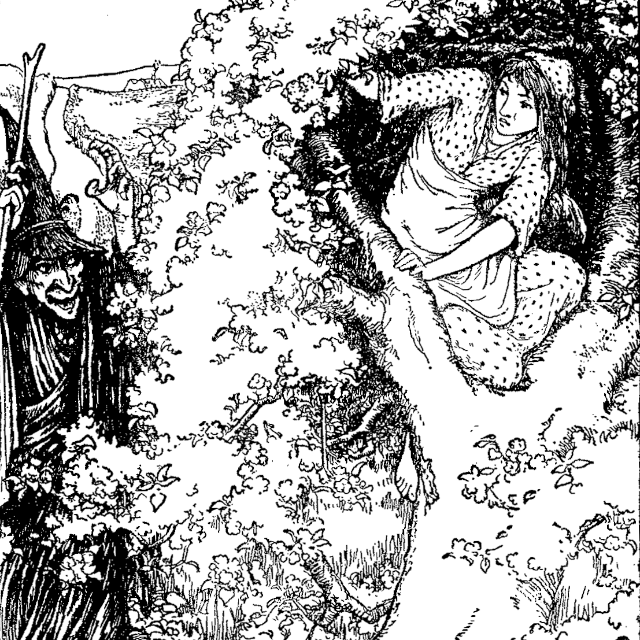
The smith's daughter who kept her tongue


$
Once upon a time, despair drove a poor blacksmith to the edge of a rope. But from that dark moment sprang a strange bargain — a black woman rising from the earth, offering him gold in exchange for “something in his house that he did not yet know about.” In accepting, the smith unknowingly doomed his newborn daughter, a golden-haired child marked with a star upon her brow.
Years later, when the mysterious woman came to claim her, the girl—called Goldilocks—was taken to a black castle filled with a hundred locked rooms and one forbidden door. Obedient and pure of heart, she resisted temptation for many years, but music one day lured her to the final chamber. There she glimpsed twelve black men and a thirteenth figure who warned her: silence alone could save her soul.
Working with Fairytales
For Jung, fairy tales reflected the anatomy of the psyche. According to Marie-Louise von Franz, fairy tales represent “the purest and simplest expressions of the processes of the collective unconscious.” Stripped of the cultural, historical, and personal layers that often obscure myths and legends, fairy tales offer the clearest window into archetypal patterns at work within the psyche.
In each session, working with a fairy tale involves four steps:
- Reading the tale — engaging directly with the narrative.
- Exploring the imagery — identifying the key symbols and motifs.
- Psychological interpretation — understanding the archetypal meaning and its relation to the collective unconscious.
- Personal reflection and application — discovering how the tale’s message relates to one’s own life and individuation process.