


Fairy Tale Analysis
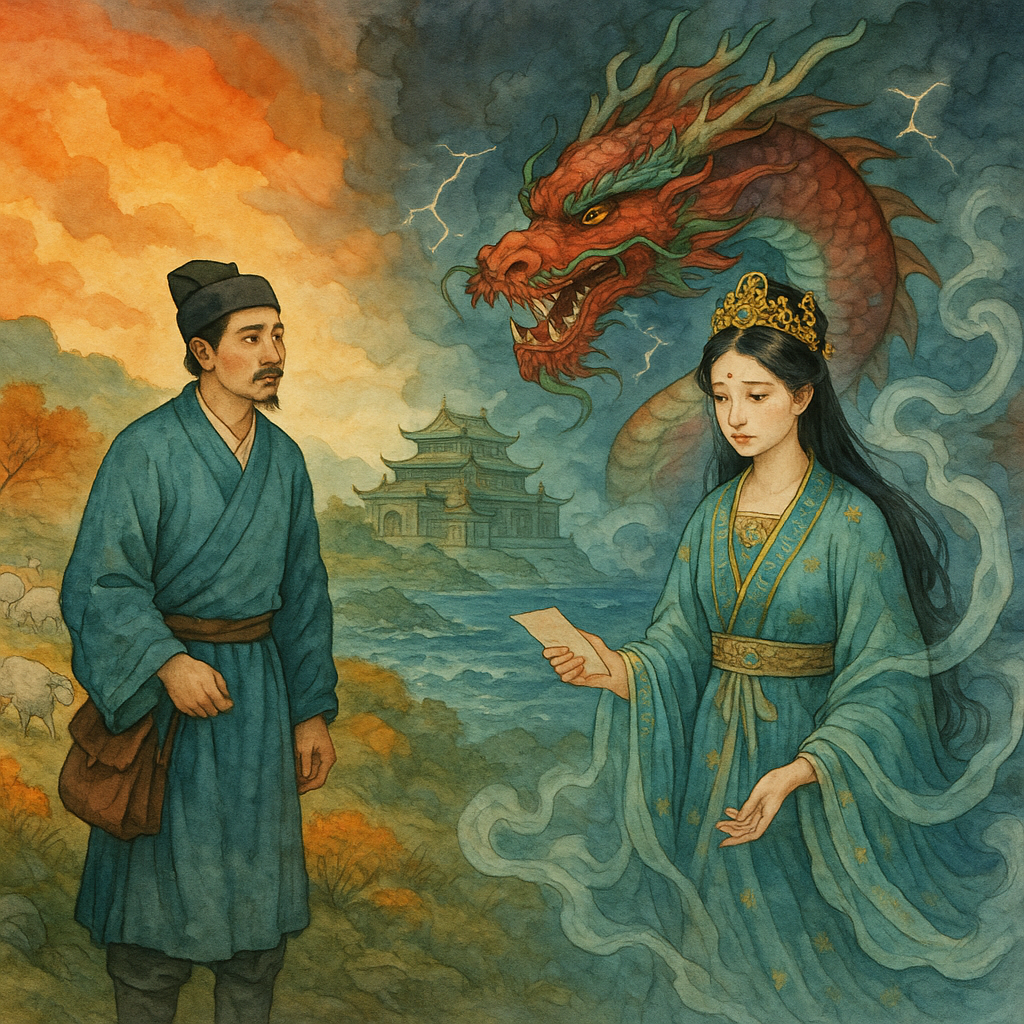
The Rejected Princess


$
The Rejected Princess tells the tale of Liu, a failed scholar whose journey home leads him into the realm of dragons and destiny. After encountering a sorrowful woman herding sheep on a hillside, Liu learns that she is no mortal but the youngest daughter of the Dragon King of the Sea of Dungting—cast out and humiliated by her cruel husband. Moved by compassion, Liu agrees to deliver a letter to her father, beginning an extraordinary adventure that carries him beneath the sea to a glittering dragon palace.
There, amid coral towers and halls of jade, Liu witnesses divine powers and elemental forces at odds—fire and water, man and dragon. His act of kindness restores the princess’s honor, earns the gratitude of the Dragon King, and brings him immense wealth. Yet fate’s circle is not complete until years later, when the princess, reborn as a mortal woman, becomes his bride. In the end, Liu transcends human life to dwell eternally beside her beneath the waves, leaving the world of dust for the luminous kingdom of the sea.
Working with Fairytales
For Jung, fairy tales reflected the anatomy of the psyche. According to Marie-Louise von Franz, fairy tales represent “the purest and simplest expressions of the processes of the collective unconscious.” Stripped of the cultural, historical, and personal layers that often obscure myths and legends, fairy tales offer the clearest window into archetypal patterns at work within the psyche.
In each session, working with a fairy tale involves four steps:
- Reading the tale — engaging directly with the narrative.
- Exploring the imagery — identifying the key symbols and motifs.
- Psychological interpretation — understanding the archetypal meaning and its relation to the collective unconscious.
- Personal reflection and application — discovering how the tale’s message relates to one’s own life and individuation process.